An
Anthology of Essays on the Lyric "I"
~EDWARD BYRNE~
EXAMINING
THE POETRY OF CONFESSION
AND AUTOBIOGRAPHY: AFTER CONFESSION: POETRY
AS AUTOBIOGRAPHY
A century after
Whitman's inclusive
ego attempted to incorporate
everyone and everything
around
him and seemingly spoke for all
the shared elements in
his beloved
democracy, the confessional poets
appeared determined to
tell those
intimate tales that distinguished
themselves as separate,
private,
and insistently unique individuals.
Now as the twenty-first
century
begins, the ambiguous legacy
of confessional poetry
persists
in its influence over many
American poets and it
inspires
ambivalent responses from critics,
readers, and sometimes
the poets
themselves.
Ever
since Walt
Whitman, our great father of American poetry, wrote the opening line
for
"Song of Myself" ÷ "I celebrate myself, and sing myself"
÷ a spotlight
has shone on the American poet's ego, and the expression of his or her
individual self, as a primary source for information, as well as
inspiration.
Indeed, this focus on the self has often been consciously proposed and
promoted by the poets themselves. However, even when American
poets
have not purposely placed themselves in the forefront of their poems,
many
readers have repeatedly sought to identify the personae and
performances
reported in the poetry with the biographical details belonging to the
lives
of the poets behind the lines.
Almost
exactly one hundred years after the 1855 publication of the first
edition
of Whitaman's Leaves of Grass, the chronicling of personal
autobiographical
matters ÷ what M.L. Rosenthal disdainfully referred to as
"personal confidences,
rather shameful" ÷ by American poets reached a peak with the
publication
of two of the twentieth century's most influential volumes of poetry,
Allen
Ginsberg's Howl (1956) and Robert Lowell's Life Studies
(1959),
soon to be followed by similarly revealing collections of poetry by
W.D.
Snodgrass, Anne Sexton, Sylvia Plath, John Berryman, and others.
In
his
essay establishing the term "confessional" for this new movement of
mid-twentieth
century poets, Rosenthal recognized a further willingness by American
poets
to open their own personal faults and frailties, their most private
histories
and intimate experiences, for close examination by the readers of their
poetry. In fact, poets' records of marital infidelities, painful
personal failures, mental health breakdowns, and incidents of
psychological
anguish were displayed on the pages for the scrutiny of readers as
easily
as innocent family photographs might be shared with friends following
travels
on a vacation trip.
Consequently,
confessional poetry was defined by its content ÷ the intimate,
sometimes 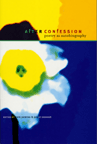 sordid,
autobiography of the poet revealed in explicit first-person narration
÷
rather than any novel technical development or formal
advancement.
A century after Whitman's inclusive ego attempted to incorporate
everyone
and everything around him and seemingly spoke for all the shared
elements
in his beloved democracy, the confessional poets appeared determined to
tell those intimate tales that distinguished themselves as separate,
private,
and insistently unique individuals. Now as the twenty-first
century
begins, the ambiguous legacy of confessional poetry persists in its
influence
over many American poets and it inspires ambivalent responses from
critics,
readers, and sometimes the poets themselves. As David Graham and
Kate Sontag declare in the introduction to their impressive recent
anthology
of essays on the art and ethics of contemporary autobiographical
poetry, After
Confession: Poetry as Autobiography, "more than forty years after
the
poets and the poetry first tagged 'confessional' ignited critical
controversy,
American poetry continues to display a notable confessional strain
÷ some
would say exhaustively and exhaustedly so."
sordid,
autobiography of the poet revealed in explicit first-person narration
÷
rather than any novel technical development or formal
advancement.
A century after Whitman's inclusive ego attempted to incorporate
everyone
and everything around him and seemingly spoke for all the shared
elements
in his beloved democracy, the confessional poets appeared determined to
tell those intimate tales that distinguished themselves as separate,
private,
and insistently unique individuals. Now as the twenty-first
century
begins, the ambiguous legacy of confessional poetry persists in its
influence
over many American poets and it inspires ambivalent responses from
critics,
readers, and sometimes the poets themselves. As David Graham and
Kate Sontag declare in the introduction to their impressive recent
anthology
of essays on the art and ethics of contemporary autobiographical
poetry, After
Confession: Poetry as Autobiography, "more than forty years after
the
poets and the poetry first tagged 'confessional' ignited critical
controversy,
American poetry continues to display a notable confessional strain
÷ some
would say exhaustively and exhaustedly so."
Indeed,
as Graham and Sontag point out, the characteristics of confessional
poetry
can now be detected, and their merits debated, in all aspects of
American
writing: "For good or ill, we live in the age of the memoir. As
autobiographies,
memoirs, fictionalized biographies, and works of creative nonfiction
fill
bookstores with ever-growing frequency, discussion of the nature and
boundaries
of autobiographical writing has grown both common and
heated."
In an effort to organize some of the various views on an apparently
ongoing
prominence of confessional or autobiographical presentations as tactics
in today's American poetry, Graham and Sontag have gathered together
commentaries
by thirty contemporary poets on "the often controversial historical,
ethical,
and critical considerations related to autobiographical poetry."
In
the
fascinating contributions to their anthology, Graham and Sontag
recognize
a lingering concern by poets and critics over the effect of the lyric
"I"
in contemporary poetry, especially as it sometimes presents a conflict
between egotistical self-absorption or embarrassingly intimate
self-referencing
by the author and the use of a first-person narration to widen the
scope
of the poem, as a tool to increase a reader's emotional identification
with the writer as actor in the work or to initiate a reader's
vicarious
sharing of the experiences and activities related in the poem.
Rather
than see autobiographical poetry as confining for the writer and
limiting
for the reader, some poets appreciate the possibility for a more
universal
effect similar to that sought by Whitman. Graham and Sontag
define
this as "the notion that first-person lyrics can embrace a larger
social
vision, achieving revelation over narcissism, universal resonance over
self-referential anecdote."
Brendan
Galvin categorizes the division between the confessional poetry of the
past and the autobiographical poetry of the present in his unique essay
"The Contemporary Poet and the Natural World":
In the work of Lowell and other confessional poets, the twentieth-
century persona (exemplified by Eliot's Prufrock, for instance)
is
replaced by a speaker who more closely represents the author, and
the poem's circumstances can usually be verified as more or less
the
author's own. Lately, however, the confession is often
contextless,
with little of the who, what, when, where, and why that might give
the reader some sense of character, setting, or incident ÷ a
few
clues to keep him interested.
A number
of the poets in this anthology seek middle ground by acknowledging that
it is frequently difficult to distinguish the self from the speaker in
one's poems, and there may be good reason not to do so. William
Matthews
observes "the 'personal' and the 'impersonal' are intricately braided,
and thus both difficult and perhaps not even useful to separate, in the
way a craft ÷ let's say the craft of poetry ÷ is
practiced. But you'd
hardly know this from reading and listening to discussions of
poetry."
Carol Frost complements Matthews' stance with her own comment that "all
poetry is autobiographical in its revelations of the motions a mind
makes.
The hesitancies, detours, innuendoes, spirals of lies and truths, as a
person remembers or invents, are as essentially personal as the facts
of
that person's life."
In
an especially
strong essay "in defense of the lyric," and one that also indirectly
offers
support to Matthews' viewpoint, Joan Aleshire reviews the past of the
lyric
"I" in poetry, and she describes how "the lyric song emerged as a short
improvisation based on the singer's life at the moment of
writing."
However, any writing of poetry arises from a poet's lifetime of
accumulated
experiences and observations. Therefore, Aleshire states: "The
'I'
is an agent of experience which, if not immediately intelligible to us
in its particulars, becomes so as the argument is presented through
sound,
syntax, and imagery." Similarly, Stanley Plumly proposes that the
act of writing about a particular moment of inspiration or
illumination,
as in a lyric poem, is one in which the author discovers "the soul of
that
moment is the common life we call autobiography, since our identities
depend
so much on that with which we identify and that which identifies with
us."
Another
commentary that looks back at the origins of autobiographical poetry is
"My Grandfather's Tackle Box," by Billy Collins. Here, he
reports:
Up until the end of the eighteenth century, poetic decorum
would remind the author that he must keep himself subordinate
to his subject matter, which would be determined by his choice
of genre. High matter for the epic, verbal coyness or
plangent
sincerity for the love lyric. For a poet to write of his own
life
÷ his discovery of daffodils in a field or his grandfather's
tackle
box in the attic ÷ would be not only self-indulgent but of
no
value to an audience interested in its own edification, not in
the secrets of the poet's past.
Of course, all this
changed with
the publication of Lyrical Ballads by William Wordsworth and
Samuel
Taylor Coleridge who, along with other "English Romantics were
encouraged
to base poems on personal experience by John Locke's notion that each
individual's
consciousness is uniquely formed."
Yusef Komunyakaa,
in a very fine essay titled "The Autobiographical 'I': An Archive of
Metaphor,
Imagery, and Innuendo," sorts out the differing use of the first person
in Wordsworth's poetry and Whitman's poetry. In their practice of
presenting themselves in their poems through the personal pronoun "I,"
Komunyakaa discerns a clear distinction, one that reflects the concerns
mentioned earlier, particularly the conflict between egotistical
self-absorption
and the use of a first-person narration to widen the scope of the
poem.
Komunyakaa determines that Wordsworth's "I" is "more self-centered and
egotistical, Whitman reaches for a crescendo driven by sheer force of
will
like a birth-cry and death-cry woven into one impulse. Whitman's
'I am,' a self that embodies imagination, travels beyond the
personal."
Again, echoing the essays by Matthews and Aleshire, Komunyakaa confides
that for him the speaker in Whitman's poems is effective because he "is
often a universal 'I' whose feelings have been shaped by experience
and/or
imagination, an empathetic witness."
Reading
this essay, the reader is treated to a wonderful account of how
Whitman's
poetry influenced the younger Yusef Komunyakaa from the time he first
opened
a copy of Leaves of Grass at the local library:
. . . Whitman would help me discover the undivulged mysteries
of my surroundings÷his terrifying, lyrical vibrancy that
exacted
an elusive beauty in life. He told me that my own rough song
could also embrace a believable, shaped lyricism made of
imagination
and experience. As a matter of fact, imagination, not only
what's
observed, also counts as experience. And, since the artist, the
poet,
isn't just a reporter of the so-called facts, Whitman, seems like
an
act of conjuring. He reinvents himself on the page, singing
his
imagined self into existence, into immortality through a lyrical
urgency.
The "lyrical urgency"
Komunyakaa
finds in Whitman's poetry represents one of the elements that
characterize
much of the last few decades of contemporary poetry.
Following
the confessional poets, and their emphasis on intimate narratives, many
postconfessional poets have borrowed an interest in exploring personal
autobiographical experiences as sources for their poems, but with an
enhanced
primary focus, as in Whitman's work, on lyrical poetry's ability to
transcend
the individual's personal condition and appeal more widely to readers
through
realization of a universal understanding or shared emotional response
to
the autobiographical experiences examined in their poetry.
Postconfessional
poetry endeavors to achieve the "lyrical vibrancy that exacted an
elusive
beauty in life," the amazing quality, combining "imagination and
experience"
that Komunyakaa found so moving in Whitman's Leaves of Grass.
In
doing so, many contemporary poets have managed to write poems of
personal
experience while at the same time avoiding the criticism confessional
poets
like Lowell, Plath, and Sexton received for their most unrelentingly
intimate
works resembling scenes from a private documentary, even from
sympathetic
readers like Elizabeth Bishop, who confided to her friend Robert Lowell
that she deplored some of the confessional elements in his poetry,
especially
what she perceived as Lowell's unethical use of confidential material
from
personal letters and conversations with family and friends.
Some poets
and critics have issued an objection to the contemporary
autobiographical
poem on other ethical grounds. Since any recounting of personal
episodes
or autobiographical experiences will naturally include fact and
fiction,
objective observations and subjective analysis, straight narration and
rhetorical embellishments, a number of writers have voiced concern
about
the ethics of presenting as truth, or a literature that carries the
appearance
of truth, what might be at best partial truth, and at worst a complete
fabrication. In After Confession: Poetry as Autobiography,
Ted Kooser courageously addresses this ethical dilemma in an essay that
indicates by its very title an intention to question a possible trend
toward
falsifying the self as first-person narrator in contemporary American
poetry:
the essay is called "Lying for the Sake of Making Poems."
Kooser
expresses a certain amount of concern and suspicion about the effort by
some poets to fictionalize themselves as the personae in poems that
present
an aura of truth, but which also manipulate the reader into believing
in
certain false events and experiences that were witnessed or endured by
the poet/speaker in the poem:
Perhaps I am hopelessly old-fashioned. Perhaps I should
accept
the possibility that what the poet says happened really didn't
happen at all, but I'm going to have to make a painful adjustment
in the way I read poetry and honor poets. I grew up
believing
a lyric poet was a person who wrote down his or her observations,
taken from life. I have always trusted the "I" of Walt Whitman
as
he dresses the wounds of fallen soldiers; I trust Mary Oliver to
tell me what birds she saw as she walked through a marsh; I trust
Stanley Kunitz when he describes two snakes entwined in a tree.
Kooser declares
his ethical stance is one that seems betrayed by a poetic persona that
pretends to be the poet narrating from autobiographical experience and
acting as the self behaving in the poem, yet misleads the reader in any
fashion. As Kooser declares: "When 'I' says something happened, I
believe it happened, and if something awful has happened to 'I,' I feel
for the poet." In this manner, Kooser seems to suggest that the
personal
lyric poem is also a contract between poet and reader, one that relies
on the agreement of the reader to have faith in the credibility of the
poet for the poem to be effective, and once that agreement is broken,
so
too is the poet's credibility in any future poems. Kooser does
not
deny the need sometimes to forge fictional experiences for the persona
in a poem; however, he believes it the obligation of the poet to
clarify
for the reader that the identified persona is not to be mistaken for
the
poet. This may especially be true when solitary poems by any poet
are published in a journal or anthology. Kooser selects the
persona
poems of Ai, which he feels could not be mistaken for the poet herself
when published in a full-length collection because "no one writer could
have had the wide variety of experience the poems present. But
when
her poems appear alone in magazines, the distinction may not be so
clear."
Consequently, Kooser feels it is the poet's duty to "in some way
advise"
the reader "that the experience presented may not be the poet's
own."
Perhaps
the most egregious ethical offense Kooser finds in poets is the
willingness
to fabricate experiences or events that engender sympathy, admiration,
or even glory for the poet speaking as himself or herself in the lines
of the poem. He believes the natural and understandable response
by readers is to feel "cheated and deceived." Indeed, Kooser
concludes
that contemporary critics and readers ought to expect higher standards
with regard to the truthfulness in personal autobiographical poems
spoken
through the persona of the poet: "It is despicable to exploit the trust
a reader has in the truth of lyric poetry in order to gather undeserved
sympathy to one's self. Why do we permit this kind of behavior in
poetry when we would shrink from it in any other social situation?"
In
an essay
titled "Degrees of Fidelity," Stephen Dunn considers the ethical
questions
raised by Kooser, but is a bit less rigid in his response. Dunn
quotes
one of his own poems, "The Routine Things Around the House," detailing
the death of his mother and a memory of an incident that occurred when
he was young. He was a curious twelve-year-old boy in 1951 who
asked
his mother if he could see her breasts: ". . . she took me into her
room
// without embarrassment or coyness / and I stared at them, / afraid to
ask for more." Dunn reports in the essay:
I tell you that she did show me her breasts. Would I have
written
so if she hadn't? I don't think I would have. I think,
though,
there
are details I made up. I've lived so long with the way I
mythologized
that event that I can't remember which ones are which. But I
do
remember feeling, after much revision, that all the details, fictive
or
actual, contributed to the poem's emotional veracity.
Thus, he seems to
maintain an ethical
balance. The most important details, especially those that might
be sensational or embarrassing, for someone close to the poet should
not
be falsified. (Indeed, elsewhere in his essay, he asks: "Is a
poem
ever worth the discomfort or embarrassment of, say, the family member
it
alludes to or discusses?") Nevertheless, Dunn sees his
responsibilty
as a poet, his obligation to the reader, in a slightly different light
than Kooser. For Dunn "the poem's emotional veracity" takes
precedence
over a strict adherence to factual truth. Therefore, other
details
that are intentionally or accidentally fictional may be included in the
poem. As the title of his essay suggests, there are degrees of
fidelity
for the poet, and the judgement one makes about this issue is just
another
part of the poet's task, one of the many choices in the creative
process
of writing a poem. It is not an easy task. As Dunn
discovered:
"The truth is that for many years the poem made me uncomfortable.
To mishandle such subject matter was to descend into the vulgar."
This apprehension
is held by other autobiographical poets who choose to be more cautious
than the confessional poets of the past. In her essay, "Family
Talk:
The Confessional Poet? Not Me," Colette Inez writes: "I'm not
confessing.
I don't extol wretchedness. I'm not after absolution for, or
remission
of my sins as in the confessional booth of my childhood." She,
too,
tries to produce a poetry that is truthful without descending to a
lower
level: "we live in an age where little separates the exhibitionist,
pornographer,
or betrayer of secrets." Inez professes her goal of transforming
autobiography into literature, but to do so "with compassionate
detachment
and discretion."
Andrew
Hudgins is another poet who appears to reach a similar conclusion that
the quality of the literature is foremost in any concerns about
disclosure
and ethical questions arising from the blending of fact and
fiction.
In his essay, "The Glass Anvil: 'The Lies of an
Autobiographer,'"
Hudgins confesses : "I am always astonished at how falsely I remember
things,
astonished at how plastic my memory is." However, like Dunn,
Hudgins
views his duty to the work as one which allows for some fictionalizing,
and he seems to be willing to compromise fact and fiction for the sake
of the literature:
Although the lies of interpretation and impressionism bother me,
they are essential. We read memoirs precisely to find out
what
one writer thinks his life means and how that life felt to the one
who lived it. As I look back over The Glass Hammer, I
say,
yes,
that is what my childhood means, and , yes, that is how it felt.
And, to make those two affirmations, I accept, however uneasily,
the lies I had to tell.
A separate
and significant section of the anthology is devoted to women poets and
autobiography. One implication appears to be that a significant
growth
of influence by women poets has coincided with the period of
confessional
poetry, including poets such as Sylvia Plath and Anne Sexton, and later
decades, and that women's voices in poetry of autobiography represent a
distinct and defining category in contemporary poetry. Pamela
Gemin's
insightful essay, "Bless Me, Sisters," exemplifies the vivid and
vibrant
body of confessional or autobiographical poetry that has been produced
by women poets since the seventies as new generations moved forward
with
the lessons learned from those women confessional poets of an earlier
era.
Gemin reports how "poet Betsy Sholl vividly remembers the day,
thirty-odd
years ago, that she accidentally picked up a copy of Sylvia Plath's Ariel,
took it home, drew a bath, eased into the tub, and began to read.
'I was afraid I'd be electrocuted,' said Sholl. 'There was all
this
current. I had never heard metaphors, similes, language
buzzing
like that.'"
In
addition
to overtly or subtly political poems that celebrate feminism or praise
the lives of women and their work, contemporary women have written
numerous
poems filled with "themes of self-discovery and identity." In her
essay, Gemin explores with admiration the variety of contemporary women
poets who have written with excellence in recent decades:
The process of attaining self-knowledge can be lonely and painful.
Some of the best women poets writing today÷Denise Duhamel,
Allison Joseph, Laura Kasischke, Diane Seuss-Brakeman, Betsy
Sholl, and Belle Waring, to name just a few÷often tackle the
tough
subjects of sexuality, love and self-worth, family history, and
cultural and political identity with fresh, ironic humor or smart,
jazzy riffs of narrative infused with the poets' love of language.
Others, like Kim Addonizio, Jan Beatty, Jane Mead, Sapphire,
and the late Lynda Hull, cut closer to the bone in sparer, more
declarative, more directly confessional tones; but for the most
part their work is ultimately hopeful.
David Graham
and Kate Sontag have gathered together in their anthology a diverse
group
of contemporary poets who offer interesting and compelling views on
what
might be the dominant form of poetry at the opening of the twenty-first
century, poetry as autobiography. As Alan Williamson writes
in his essay, "Stories about the Self":
It might be that, for a literary historian from the future, the
most
interesting technical development in American poetry in the last
two decades of this century would be the refinement of (largely
autobiographical) narrative. It would be a little surprising,
since
"confessional poetry"÷almost from the moment that
unfortunate
term was coined÷has been the whipping boy of half a dozen
newer schools, New Surrealism, New Formalism, Language poetry.
Nearly half a century
after the rise
of confessional poetry, and another century since the initial line
written
in Whitman's "Song of Myself," American poets are still wrestling with
the inner conflict created by promoting the self in one's poems,
blending
fact with fiction, balancing the private and the public, or possibly
compromising
a concern for ethical behavior in presenting one's literary persona
while
producing effective poetry. In the midst of all this, the essays
collected in After Confession: Poetry as Autobiography
represent
an important and impressive touchstone, setting a standard by which
future
discussions on this topic, of which there should be many, will be
measured.
Graham, David and Sontag,
Kate, eds. After Confession: Poetry as Autobiography.
Saint
Paul, Minnesota:
Graywolf Press, 2001. ISBN 1-55597-355-8 $17.95
© by Edward Byrne


