~JENDI REITER~
AMY MECKLER: WHAT ALL
THE SLEEPING IS FOR
The voice of these poems
is intimate
but avoids the emotional
turbulence of "confessional"
poetry.
The narrator inhabits
the world of the poems
without dominating
it . . . .
Stillness and light are the words
that come to
mind when describing Amy Meckler's first book of poetry, What
All the Sleeping Is For (winner of the 2002 Defined Providence
Poetry
Book Competition). Stillness, because the verses unfold at a
measured
pace like the natural processes that are Meckler's defining themes:
pregnancy,
the seasons, lovers' alternating cycles of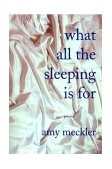 separation and reconnection. Light, not in the sense of "light
verse"
(with its derogatory hint of "lightweight") but a light touch, a
technique
so unobtrusive that its sophistication may go unappreciated at first
sight.
separation and reconnection. Light, not in the sense of "light
verse"
(with its derogatory hint of "lightweight") but a light touch, a
technique
so unobtrusive that its sophistication may go unappreciated at first
sight.
The voice of these poems is intimate but
avoids
the emotional turbulence of "confessional" poetry. The narrator
inhabits
the world of the poems without dominating it, telling her own stories
and
those of friends and family members with the same empathy and clarity
of
observation.
Meckler writes straightforward narrative free
verse, sometimes coupled with slant-rhymes and internal assonances that
spring out when the poems are read aloud. For instance, in
"Perspectives,"
the repeated sounds that twine through the poem create a harmony that
shows
the strength of the lovers' relationship despite arguments and fears of
abandonment. That reassurance is not easy or definitive, but
rather
a leap of faith that must be periodically reaffirmed.
Many of these brief poems work as extended
metaphors, in which a seemingly prosaic scene is suddenly shown to
reflect
a highly charged personal truth. The stakes are far higher than
you
realized at the beginning, when the poem innocently invited you into
the
game. Among the strongest of these are "Bridge Half Gone," "The
Thing
I Wanted to Say," and "Bad Timing." The shift occurs so deftly,
the
emotional trap is sprung so quickly, that the reader looks back
bewildered
and vulnerable, looking for the hinge on which it turned. How did
we get from a subway ride to a father's love and loss? From
tea-time
to seduction? As Meckler describes it in "Slipping Glimpser":
The
quick flinch,
late
turn of the
head. Vapor,
glint of speck.
Sun on frog's
glassy eye,
for example. The moment
you can't have
back. One word
not heard at
the crook of a confession."
In "Bad Timing," the opening image
of a train
just missed becomes a symbol of a failed relationship with a
lover.
The theme is emphasized by the use of slant-rhyme, which unfortunately
stumbles in the penultimate verse: light/fated is stretching the
definition
of a slant-rhyme, and Jetway/appeared just doesn't sound like one at
all.
I
shift from
hip to hip awaiting the next train.
Familiar failure
of tin and bone
how doors slid
shut as I approached
and my arm would
not reach
to
part them,
fearing amputation.
You came to
mind, the motion
of your empty
track I waited beside,
dial tone, your
new queen bed
where
we made
a little noise
we mistook for
chants or vows.
I knew before
you how brittle
we would grow
inside that rattle.
Similarly, in "Bridge Half Gone,"
repair work
on the Williamsburg Bridge between Brooklyn and Manhattan exposes the
fault
lines in a relationship. To her lover, who lives next to the
24-hour
din of the construction work, the speaker jests, "You're only in my bed
/ to get some sleep, aren't you?" But later lines reveal that
it's
no joke:
In my
own bed,
you push me
as far away
as you can.
Balled in your
pod, you sleep
as if there
is no one
just outside
your walls
taking herself
apart.
Meckler's technique of pairing
scenes is used
to powerful effect in "The Next Day," in which the story of a child
saved
from charging rams by her father and sister segues into a date rape
where
there was no one to rescue her. In contrast to the extended
description
of the rams' onslaught, which has the slow-motion weight of nightmares,
the sexual assault is revealed only in staccato sentence fragments:
"Backfire
beyond the garbage alley beating through / the shut window in my
apartment.
/ First date. I thought I knew him." Did the earlier incident
really
happen, or is it a mythic reinterpretation of events too devastating to
confront directly? The poem's opening words, "I think of myself
as
a little girl," leave both interpretations open. Overall, this
sure-footed
first collection is a promising start to Meckler's poetic career.
Meckler, Amy. What
All the Sleeping
Is For. Fort Montgomery, New York: Defined Providence Press,
2002.
ISBN: 0-967-3495-4-0 $12.95
© by Jendi Reiter


