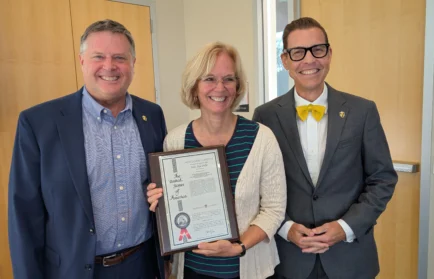
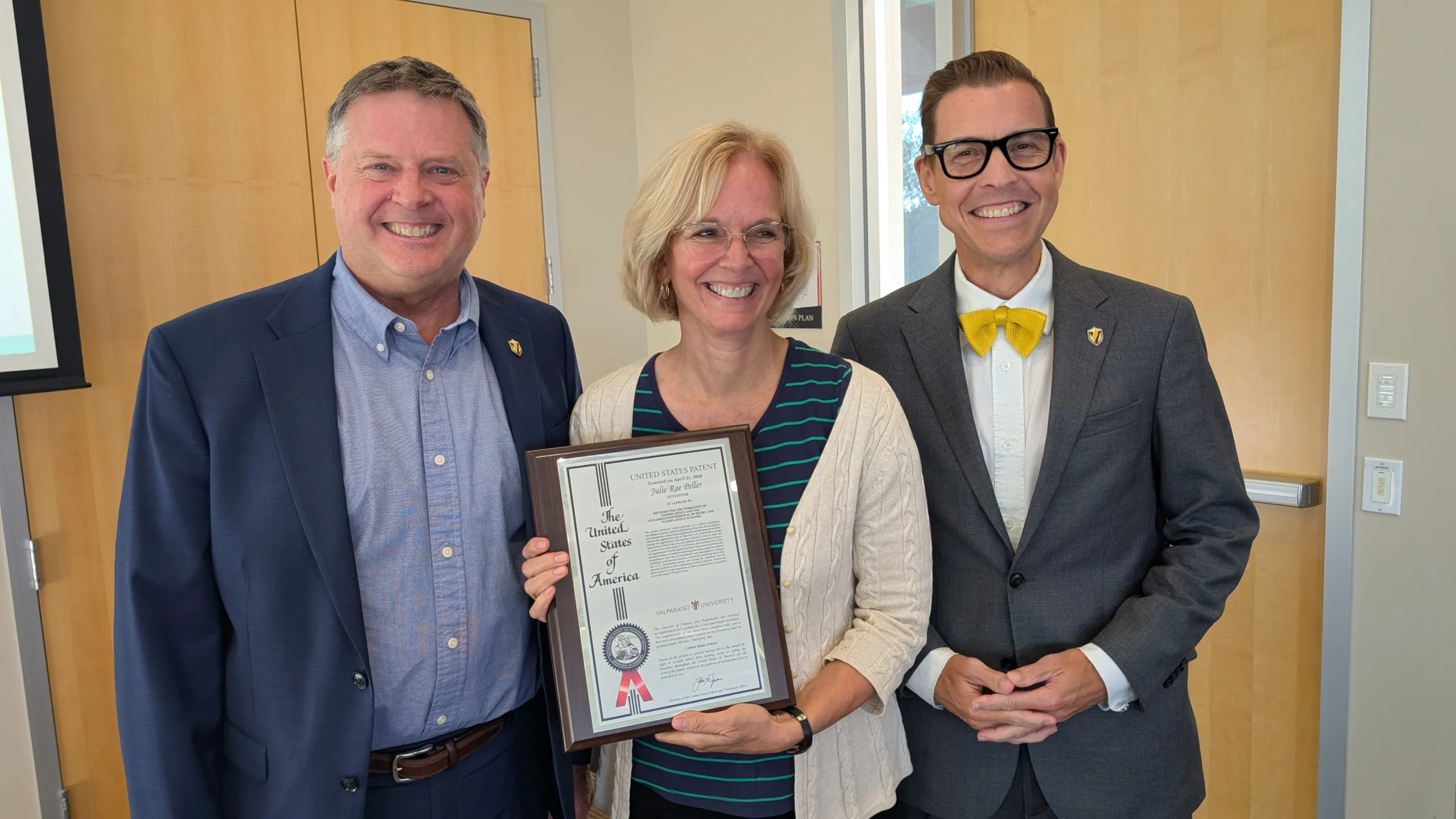
Julie Peller, Ph.D., professor of chemistry at Valparaiso University has received a patent entitled “Methods for the Formation of Nanoplastics and the Agglomeration and Removal of Microplastics/Nanoplastics from Water.” With recent data from Stastita reporting 360 million tons of plastic waste being generated each year worldwide, this work from Professor Peller and her collaborators represents a significant step forward in the ability to understand this pervasive form of pollution.
While the impact of micro and nanoplastics on human health is in the early stages of research, there is no denying that said plastics can be found inside almost every person on Earth. Even simple actions like placing or removing the lid of a water bottle can grind imperceptibly tiny plastic particles into the water. Human health is not within the scope of Professor Peller’s research, but her work may open important doors for specialists in that field looking to pursue the topic.
“Dodecane can mimic parts of fatty tissue,” Professor Peller said. “So this method not only helps us create new solutions, it can also help new collaborators get new insight into their work with body tissues.”
Microplastics and nanoplastic do not evenly mix with water under normal laboratory conditions. The addition of dodecane, an oily substance that also typically does not mix with water, creates conditions that cause both substances to disperse evenly throughout a sample after ultrasonic mixing. Using this method, an observer can create mixtures of plastic particles of certain sizes in water, allowing them to simplistically simulate a wide variety of environments where plastics are present, including conditions within the human body.
Outside of humans, bodies of water in nature can contain organic substances similar to dodecane, causing this type of mixing to occur naturally in places like Lake Michigan, where Professor Peller and her students have done significant work gathering and cataloging various types of plastic waste.
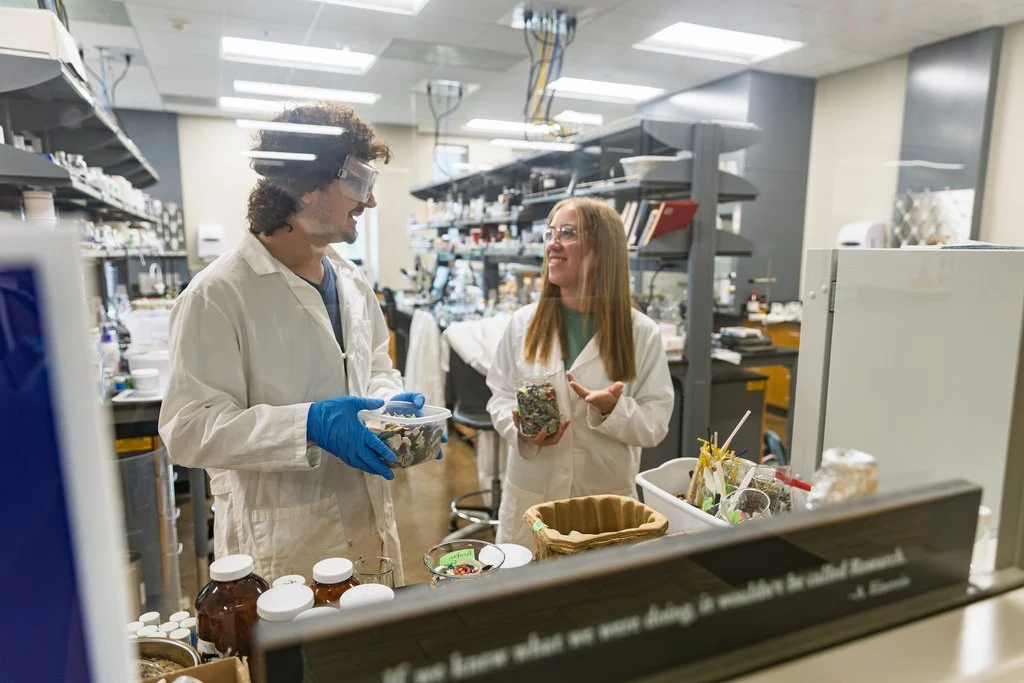
“Plastic doesn’t degrade at all, it just breaks down smaller and smaller until you can’t see it, and it could be posing a health risk,” said Jaden Gibson ’27, a chemistry major performing research on the breakdown of plastic waste under Professor Peller. “And obviously the environment is also suffering. Getting to understand the science behind the fragmentation is incredibly important.”
The portion of the patent regarding the agglomeration and removal of micro and nanoplastics utilizes a similar substance, hexadecane, to cause the plastics within a sample of water to clump together for easy removal when mixed effectively. This method has proven successful regardless of the purity of the water or type of plastic, but has not been tested for larger scale removal. Dodecane can also be used in the agglomeration and removal of plastics, but Professor Peller and collaborating faculty and graduates from the University of Notre Dame have found that hexadecane is more effective.
Both aspects of the patent will be the subject of continuing research at Valparaiso University. Professor Peller will work with chemistry majors like Gibson and Vincent Grisolano ’28 to perform additional tests with the solubilizing process, while environmental engineering students from both Valpo’s College of Engineering and the University of Notre Dame under the supervision of Kyle Doudrick, Ph.D., will continue to develop and refine the agglomeration process.