
Timothy Malchow, Ph.D., professor of world languages and cultures at Valparaiso University, was recently named Teacher of the Year by the Indiana Foreign Language Teachers Association and the Collegiate Teacher of the Year by the Indiana Chapter of the American Association of Teachers of German (AATG). The Teacher of the Year award is given to a state teacher of any language to recognize “outstanding effort and achievement in foreign language instruction and professional service in the state of Indiana.”
Valparaiso University’s robust German language programs have provided Professor Malchow with plenty of opportunities to engage in in-depth language instruction.
“At Valpo, what’s most important for us is to be able to do many different things for many people,” Professor Malchow said. “To be active scholars, but to think about students at all levels. We have students who’ve never studied German before, and we have to have the ability to teach cutting-edge German studies for those who come in with a strong background.”
Professor Malchow’s honors exemplify how German language education is alive and well at Valparaiso University through a number of programs, resources and opportunities.
German Minor and Individualized Major
By combining German classes with another, relevant subject (such as history or economics), an approved student can still receive a degree that will qualify them for the same opportunities as a student with a B.A. in German. A teaching license in German may also be obtained this way through the education department.
The proposed major must be approved, and must contain 30 credit hours that cannot be general education courses or courses for another major.
Additionally, a German minor fits well with most academic majors at Valpo.
Study Abroad with Scholarships
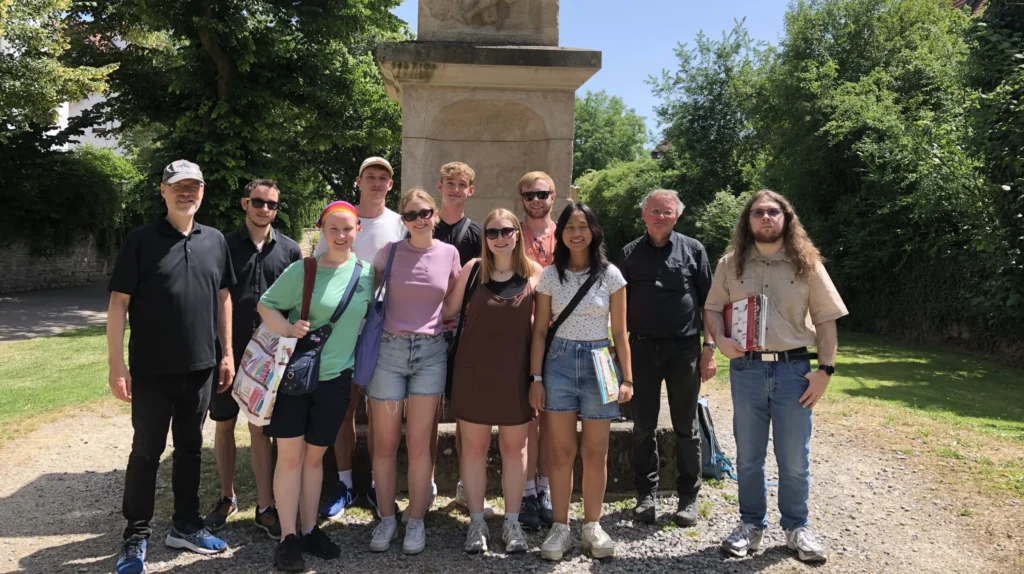
Valparaiso University created its first study abroad programs in 1968. At that time, students had two options: Cambridge, England for those seeking an English- speaking experience, and Reutlingen, Germany, as a testament to the school’s deep, German roots. Today, that relationship with Reutlingen continues to be a strong one, with Valpo students seeing ample opportunities to take their education abroad.
“We have a closer relationship with the Reutlingen program than perhaps many other German programs at other universities, which has made it possible for us to place our students in internships and cooperative education,” Professor Malchow said. “The deep relationships that we have makes all of that smoother and makes it possible for us to think creatively about how to improve.”
Those pursuing an individualized major in German, as well as students minoring in German, are automatically eligible for Giebel scholarships to support study abroad on a semester- or year-long Valpo program in Germany. These scholarships are administered through the Kade-Duesenberg German House and Cultural Center (see below) and can be added to existing financial aid. They require a B-minus average and, for non-commuters, residency in the German House before departure.
The Valparaiso International Engineering Program in German (VIEP-German) gives those in the College of Engineering an opportunity to not only study their field in another country, but also spend a semester working in a German lab or company as part of a cooperative education program. VIEP-German students complete an Engineering major and at least a German minor.
In most cases, students that qualify for studying abroad retain the scholarships and assistance they would have gotten at Valpo, and students on year-long study abroad programs enjoy free housing as part of the Giebel Scholarship.
“Our philosophy for all our study abroad support is that we don’t want someone studying German to pay more to spend a semester or year in Germany than if they stayed here in Valpo,” Professor Malchow said.
The Kade-Duesenberg German House and Cultural Center
Thanks to a generous donation by the Max Kade Foundation and Phyllis and Richard Duesenberg, the Kade-Duesenberg German House and Cultural Center has stood as a campus landmark since 2000, opening exciting opportunities for German language students to hone their skills and give back to the community.
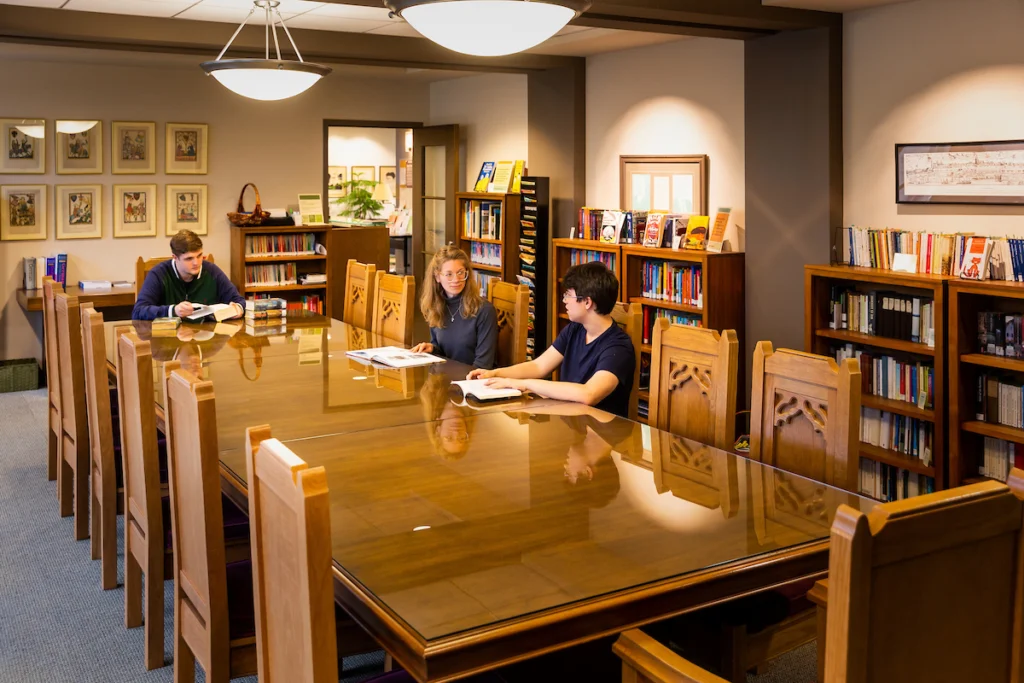
Thirteen students, including one native German speaker, are able to live in the suite- style accommodations where they agree to speak German in common areas (lounges, kitchens, computer lab, etc.). This day-to-day language practice gives them a level of experience and competency that will be invaluable throughout their academic careers and beyond.
If all available spaces are not taken by German language students, the house becomes a World Language Community. Remaining rooms are filled by students in French and Spanish, who agree to speak those languages together and bring their skills and experiences to an intercultural discussion.
The German Cultural Center on the ground floor has attracted numerous professional events and workshops in the German language education sector. In 2019, the AATG brought 30 teachers from across the country to the Kade-Duesenberg House for a 3-day conference funded by the German government. A similar, statewide event took place in 2022, and the Center hosts regular dinners and workshops for German teachers of all levels. The Center also brings an annual Josef Eberle Visiting Scholar from Germany to speak on campus.
Learn more about the Kade-Duesenberg German House and Cultural Center here.
House residents and other students of German are also the face of the program for visiting high school students, and the main contributor to one of the programs’ largest public-facing efforts: Kinder lernen Deutsch.
Kinder lernen Deutsch
Those interested in learning a foreign language at Valpo don’t have to wait until college or even high school to start pursuing their German education. Kinder lernen Deutsch is a weekly program for kids from grades 2-4 that teaches children the basics of German through activities, games and songs. Beginners and those with prior exposure to the language are both welcome.
“This is a way for children, at an age where they’re especially able to engage with language in a playful way, to have the experience of learning,” Professor Malchow said. “Then, when they get to middle school and high school, they are already familiar with language study.”
Valparaiso University German students who are excelling in their discipline do the majority of the teaching, and reap the benefits of getting real-world instructional experience. Several previous Kinder lernen Deutsch instructors have gone on to be high school German teachers around the country and Fulbright scholars teaching around the world.
The Kinder lernen Deutsch program accepts new registrations in early fall. To learn more, click here.
German and Valpo’s Mission
While the study of German has changed and evolved over the decades, the language has played an important role in shaping the University’s identity as an institution from its very beginning.
“If we look back at the history, it’s important to recognize that Valpo has an unusually large number of resources dedicated to German because we were founded as a Lutheran University by German-American Lutherans,” said Professor Malchow. “That history has allowed us to accumulate a lot of resources and programming, and people should know about that.”
Fostering opportunities for studying and experiencing German language and culture is living Valpo’s mission of providing the best student experience possible, both for their career prospects after graduation, and in their personal growth. As the fourth largest economy in the world, and the largest in the European Union, Germany and German-language skills are a valuable asset to any future professional with global aspirations. Through study abroad programs, students solve communication hurdles, build relationships with people of vastly different backgrounds, and learn to navigate a diverse world.
“Our students abroad have encounters with people in a safe environment where they are the outsiders,” Professor Malchow said. “That helps them see the world, and others, from a new angle. Many alumni report that these transformative experiences have effects that last a lifetime.”