






O God, you have called your servants to ventures of which we cannot see the ending, by paths as yet untrodden, through perils unknown. Give us faith to go out with good courage, not knowing where we go, but only that your hand is leading us and your love supporting us; through Jesus Christ our Lord. Amen.
Powerful and simple, these words have anchored generations as “the Holden Prayer”–a beautiful invocation ubiquitous at the remote Holden Village retreat center in Washington State’s Cascade mountains. My now college-aged niece used to regularly and charmingly intone this litany at a very young age, her solemn emphasis on the “good cou-wage” we needed to remember and carry with us. Indeed, it’s hard not to “go out with good courage” when the person entreating you to do so is a bright-eyed, earnest toddler clad in footed pajamas.
I learned only recently that the prayer originated in the UK in 1941, penned by Eric Milner-White, then dean of King’s College, Cambridge. Titled “The Call of Abraham,” this supplication would have landed amid communities rocked by World War II and the bleak despair of the bombing raids. (The “Blitz,” or Luftwaffe campaign, reached its crescendo in that same year, in fact.) “Perils unknown” loomed large, and not as the evocatively crafted language of vague abstraction. How do you put one foot in front of the other, in a time when assumed certainties suddenly collapse? When the way seems futile and the path not just untrodden but alarmingly uncertain?
The prayer serves as a reminder and a spur onward. While it does not minimize the very real precarity, neither does it allow such uncertainty to define the moment and or the larger truth. We are led, we are loved, and we are supported…despite the contours of the journey and its possible destinations.
As Lutheran pastor and writer Nancy Winder recounts, “The Call of Abraham” was introduced to the broader US Lutheran community in 1958, when the president of Lutheran Theological Seminary (Philadelphia) incorporated the prayer into the 1958 Service Book and Hymnal. In the “Collects and Prayers” of the SBH, “The Call of Abraham” found new life as “For Guidance,” number 96.
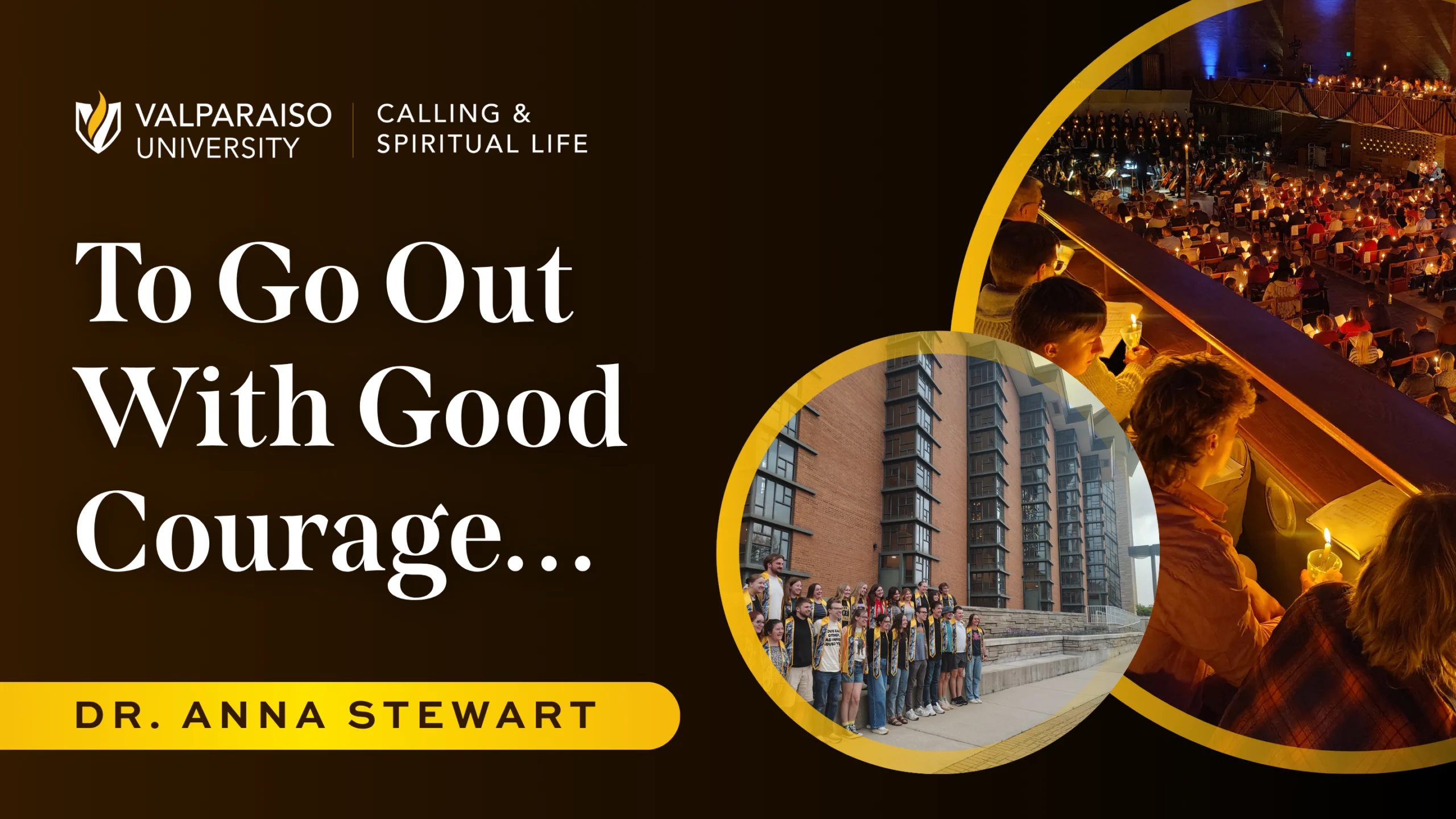
The prayer quickly became a standard when Holden Village launched; my husband’s maternal grandparents, Carroll and Mary Hinderlie, invoked no. 96 regularly as Holden’s first directors in the early 1960s. Over time and with such repeated use in the Village, the words became familiar in widening circles as “the Holden Prayer”–reference to a treasured petition at a retreat center where thousands came for peace and renewal. We recite it frequently at Valparaiso University, most especially at baccalaureate and commencement ceremonies, where we pray for and with our graduating seniors as they “go out with good courage” from this place toward the next adventures on their journey.
Not unlike Holden Village, Valparaiso University serves as a place that people (and particularly students) are always coming to and departing from. It’s a community where we sojourn, learning and exploring both richly and well–as we determine how best to learn, explore, serve, and take the next, faithful step in the wider, beckoning world.
So many people (including Valpo students and Holden folks) have taken this prayer with them, and praying it has become part of their everyday lives. My family is no different. Indeed, the Holden Prayer has become an almost nightly prayer we say with our children…which is a little humbling if you think about it. (Apparently the Graber-Stewart family never really knows exactly where we’re headed, because those words seem to ring true regardless of when we say them!)
Virtually the whole of the prayer is about uncertainty, about traveling without a map, and about what it takes to go out anyway. The certainty meets us at the beginning and the end, with God. God calls us together, and individually, to be servants, to travel amid the uncertainty of the middle of the prayer, with a faith that there is a hand that leads, a heart that holds, and a helper who attends us no matter the road we travel or the turns we take.
What a gift there is in that promise–perhaps some glimmer of a graduation gift. A poem for the road.
And we know, moreover, that we carry not only that prayerful promise with us, but also the inherent truth of our God-given good-ness, our enough-ness, in a world where it can sometimes be difficult to remember the abundance of grace always surrounding us.
A favorite writer of mine, Barbara Brown Taylor muses on this poignantly in Gospel Medicine. She remarks on our very human tendency to feel like we must earn, or achieve, or live up to some never-quite-defined standard. If we are going out in the world and doing this or that, we assume, and if we’re really and truly called, then surely we must need to hit some vocational mark.
Riffing on Isaiah 49, Brown Taylor proffers an antidote, a dose of “gospel medicine” to guard against that infectious lie we often tell ourselves:
What if the real measure of our extraordinariness is not our thoughtfulness or our friendliness or our busyness but our spark? What if the real sign of our witness to the light is not how much we accomplish but our own lightness, our own reflection of the bright God who has chosen us and lit us up and sent us into the world like candles into a dark room? (161)
You have been called for and toward something greater than only a professional commitment or another course of study or whatever equally valid responsibilities you might hold. Those doubtless matter of course, but they do not wholly define and determine you. “What you have been called to do,” insists Brown Taylor, “is to ignite, enflame, combust, burn, shine with the glory of the God who has chosen you, and given you to the world, bright lights to the end of the earth” (161).
Amen.
As we close the book on this academic year and as some of us cross that commencement stage in the ARC, graduating into new chapters and adventures, may we hold these truths close as parting gifts. While we fittingly celebrate our achievements, may we also remember that our lightness, our reflection of the Light, does not brighten or dim due to effort or accomplishment. Rather, humbly and with full hearts, may we have “faith to go out with good courage, not knowing where we go, but only that [God’s] hand is leading us and [God’s] love supporting us.”
Blessings on your next faithful steps and the journeys we all take.
– Dr. Anna Stewart
Director, Institute for Leadership and Service