Earlier this year, friends from the Network for Vocation in Undergraduate Education (NetVUE) gifted me a copy of Norman Wirzba’s 2024 book, Love’s Braided Dance: Hope in a Time of Crisis. It’s a powerful volume that testifies to an ever more urgent need: how should we live in a world we find increasingly riven apart–from the challenges facing the atmosphere and natural world to those confronting human neighborhoods and communities? Wirzba posits that our ultimate flourishing relies on embracing our critical mutuality, the shared vulnerability that can bind us together and point us toward a more hopeful horizon.
“Hope is born in spaces of vulnerability,” he writes. I find myself drawn to this evocative language even as I shrink from its weighty substance. What does it mean to “open [ourselves] to, and allow [ourselves] to be moved by, whatever trouble and whatever goodness” surround us?
I witnessed a glimpse and a reminder several weeks ago when a massive derecho storm, fueled by both El Niño and climate change, ravaged northwest Indiana, leaving previously unseen devastation in its wake. Having grown up on South Carolina’s coastal plains, I keenly recall Hurricane Hugo’s aftermath in 1989–how once sheltering live oaks, their foliage dappling the sunlit grass, were toppled violently; boats tossed miles inland to unsuspecting backyards.
Now, some thirty-seven years later, I observe a similarly eerie catastrophe in the unlikely Midwest, where uprooted silver maples and black walnuts, laying splintered among tangled power lines, evoke poignant sympathy. My daughter quietly remarks: “Those trees make my heart hurt.” Days later, my thirteen year-old son wipes out badly on his bike, and my husband and I are grateful, hunched in the sterile white light of the emergency bay, that he suffers only a broken arm, a few cuts, and some painful road rash. For over a week, there is no electricity at home, and communication is limited as cell service cuts out unpredictably. A university generator powers the Harre Student Union, and clusters of us flock there appreciatively several days in, charging batteries as we check in with one another. Everything feels very close to the surface, charged and fragile. Yet despite these challenges in the storm’s wake, I’m aware of the uncomfortable inequalities laid bare across the region I now call home, where recovery and restoration arrive more slowly for neighbors living across county lines.
Reading Wirzba’s text feels providential against this setting. Love’s Braided Dance and the past few weeks have offered a reawakening to the beauty and fragility of all things, urging an embrace of the mutuality connecting us to each other as humans and to the natural world we too often overlook. In the day-to-day cadence of ordinary life, I’m frequently insensitive to such interdependence. I can forget the depth of the person underneath whatever role they may be inhabiting in our interaction. Physical, earthly surroundings can too readily become the backdrop on which I project some mortal ambition. I lose sight of the fact that I am a small player in a much larger drama I but dimly perceive. This obliviousness is hardly atypical. Still, my sudden recognition of creaturely finitude following the derecho storms extends anew the gift of “resonance”–an idea Wirzba fleshes out, drawing on sociologist Hartmut Rosa and with a tip of the hat to Henry David Thoreau:
“The best life is one that attunes itself to the places we are in and to the diverse creatures we are with. The best life is a resonant life that, like a tuning fork that responds to the vibration of another tuning fork, vibrates to the pulsing life of others” (64).
Contemplating ourselves as tuning forks–alive to all surrounding us and throbbing with shared vitality–feels both necessary and vocational to me on this bright September morning. I’m conscious of the generous “tuning” all around me–from the Good Samaritans who came across my son and paused their days to tend him; to the shading sanctuary of undamaged trees, shielding late summer heat; to the students and colleagues reaffirming new spirit and possibility to one another during convocation rituals in the Chapel of the Resurrection.
Rather than breathlessly chasing the lie of some “optimized” version of life, chock full of supposed achievement and conspicuous consumption, what we’re offered instead is tender, relational, resonant reciprocity. It’s a gift sometimes painful to open, but one with the benefit of being both true and real.
“Hope is born when people come together and commit to the nurture of each other and their shared places. … [We] demonstrate our shared vulnerability and self-insufficiency, but also our fidelity to live for each other. … Hope is the power that propels people to give themselves to the care and celebration of life with fellow creatures” (Wirzba 150).
Life and possibility teems around us, and it is not only hope that seems born in this beautiful mutuality. It is vocation itself, a powerful calling if we can but listen and heed.
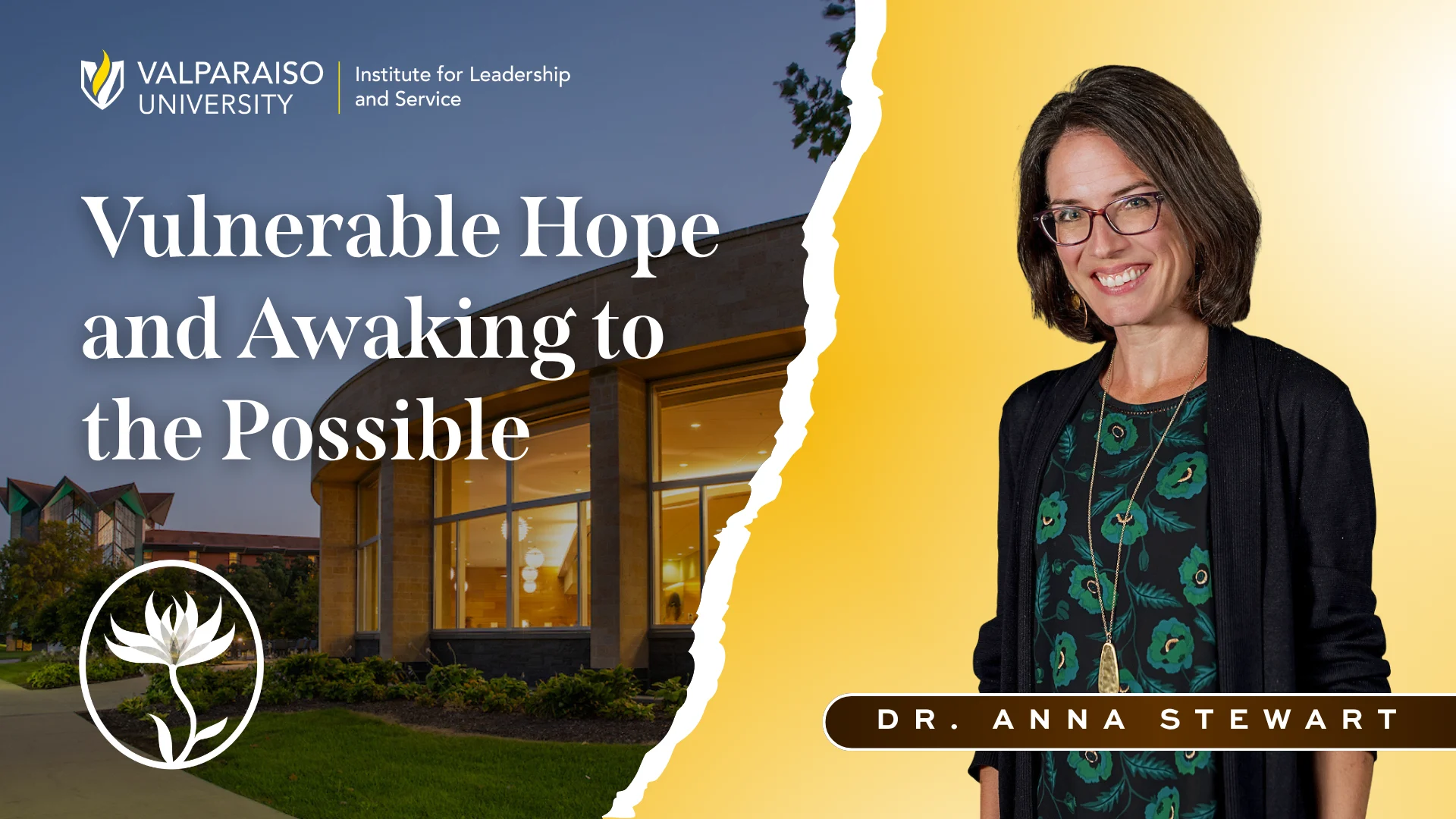
– Dr. Anna Stewart
Director, Institute for Leadership and Service
The Institute for Leadership and Service staff takes turns with the Pastoral Staff to write bi-weekly reflections and devotions for the University community.