




If you’ve walked past the manufacturing lab in the Gellersen Engineering and Mathematics Center, you may have noticed a few lightsabers hanging nearby. These laser swords aren’t just props. They’re proof of what Valpo engineering students can build once someone hands them the reins.
That someone is Matt Campbell ’11, mechanical engineering laboratory instructor, alongside Simon Sunblade ’15, technical equipment specialist. Together, Matt and Simon keep Valpo’s engineering labs running – both as technicians and instructors. They once sat in the same classrooms as the students they now mentor.
Two Paths, One Destination
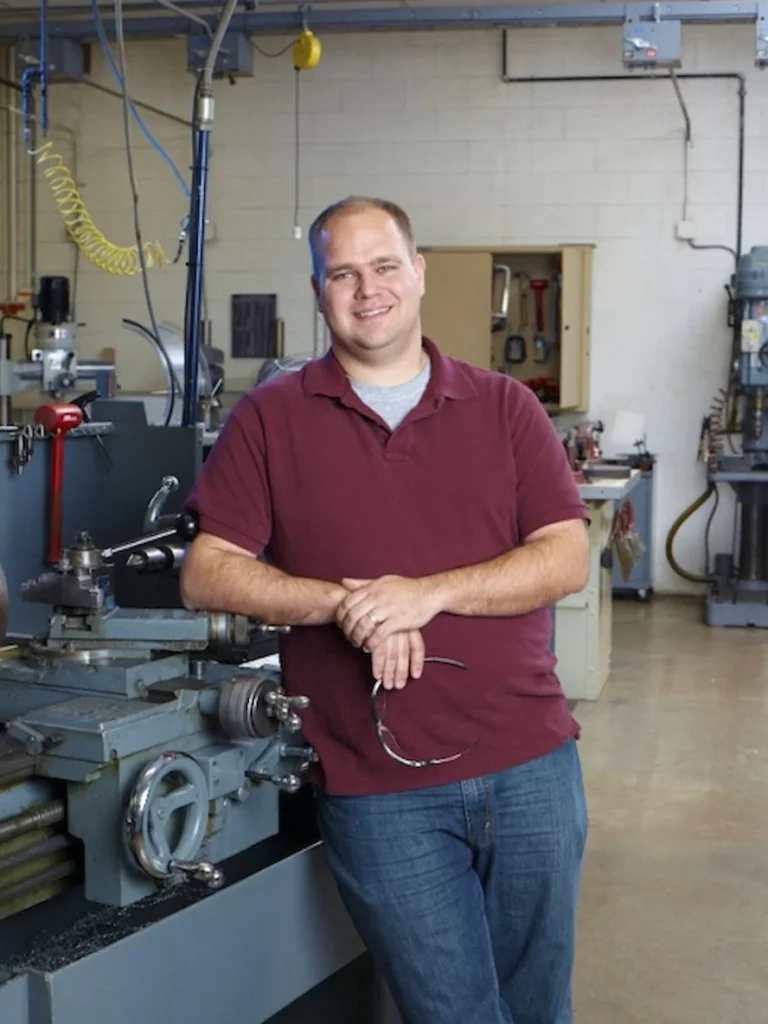
Matt’s career started when he was just 10 years old, helping his grandfather work on heating and cooling systems. He grew up to serve as an electrical technician for the United States Army, then settled into a successful career in avionics. Then, his employer at the time suggested he earn his degree in mechanical engineering.
Matt began his studies at the University of Utah, then transferred to Valpo when his wife, a local pediatrician, accepted a new role in Northwest Indiana. Valpo’s nationally regarded engineering reputation, combined with the Yellow Ribbon Program that covered nearly all of Matt’s tuition, made the College of Engineering the right choice.
“I was a non-traditional student,” Matt explains. “I was in my thirties. I had a wife and a child, so I wasn’t going off and hanging out at parties. But I did have fellow students who were friends, and I’m still in contact with some of them today.”

Simon’s road to Valpo was just as winding. He first tried college when he was 18 years old, stepped away, then returned to his studies at Ivy Tech Community College at 26. When it was time to transfer into a four-year program, he was surprised to hear that Valpo – a campus he’d grown up driving past – was home to one of the most respected engineering programs in the country.
“I liked that I could hit the ground running here,” Simon says. “It was very structured. I knew exactly what classes I would need to graduate and how long it would take.” He officially transferred into Valpo’s electrical engineering program at 28, where he received a traditionally warm welcome. “I made friends who were six years younger than me, and it was a good time.”
After graduating from Valpo, Matt took his degree back into the industry, where he gained 11 years of experience across three different fields of engineering. His path back home began after seeing a job posting from his former advisor, Professor Emeritus of Mechanical Engineering and Bioengineering G. Scott Duncan, Ph.D. “I really enjoy teaching. When I was working in the industry, part of my job was training customers and distributors. So, the role seemed like a good fit,” Matt says. “I’ve been here for about five and a half years now.”
Meanwhile, Simon had been installing control systems for The Region’s steel mills before moving into boiler work – a job that kept him on the road. Then, he saw this job opening and fondly remembered his time as a Valpo student. “The dean, Doug Tougaw [’05 MBA, Ph.D., P.E.], was one of my professors when I was a student, and most of my other professors were still here, too,” he says. “They were all very nice. So, I figured this would be a great place to work.”
For both Matt and Simon, returning to Valpo has meant giving something back. “One of the things I love most about teaching is that, once you give your students that knowledge, they have it with them forever,” Matt shares. Simon wasn’t sure how much teaching would appeal to him, but he was pleasantly surprised. “Now that I come back here, I get to teach some classes, and I realize not only do I like doing it, I’m decent at it, too,” he says. “I put in a ton of effort for every class that I teach.”
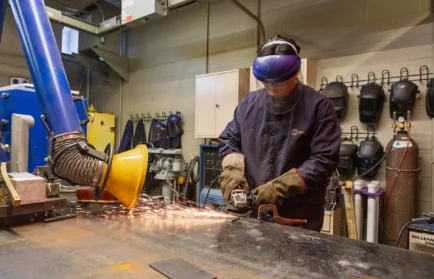
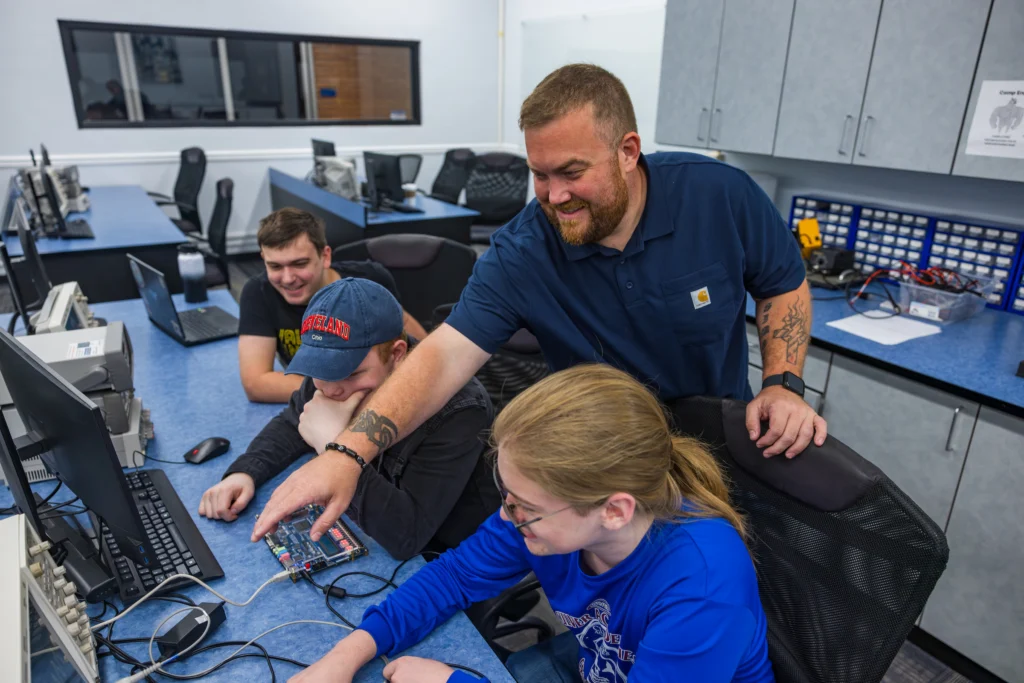
On the other side of teaching is a long list of hands-on work. Matt and Simon maintain the college’s essential lab spaces and machinery, from 3D printers to CNC (Computer Numerical Control) machines to cooling systems. “[We] have to know how all the lab equipment works, at least at a very basic level, in order to understand what we’re supposed to do if it breaks,” Simon explains. Their mastery ensures that our students have the best possible learning experience from start to finish.
Industry Experience Brought Home
While many faculty members go straight from study to graduate school to teaching, every lab and lecture Matt and Simon lead is directly informed by what they’ve learned in the field.
“I try to color that industrial experience into all my lectures. I try to tie everything back to real-world things that the industry wants from their engineers,” Matt says. Instead of placing more pressure on them to learn everything all at once, he prepares them for a career of learning. “At any point in [their careers], they might come across something and think, ‘I don’t know this and I need to learn it.’ And that’s the skill that matters,” he continues.
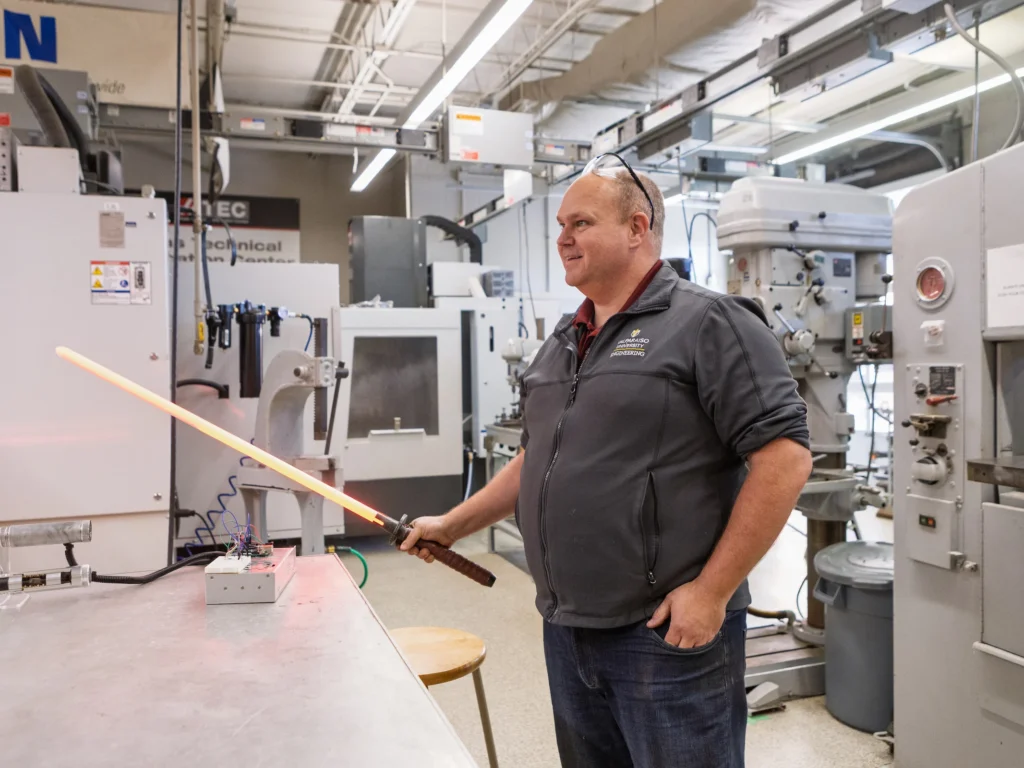
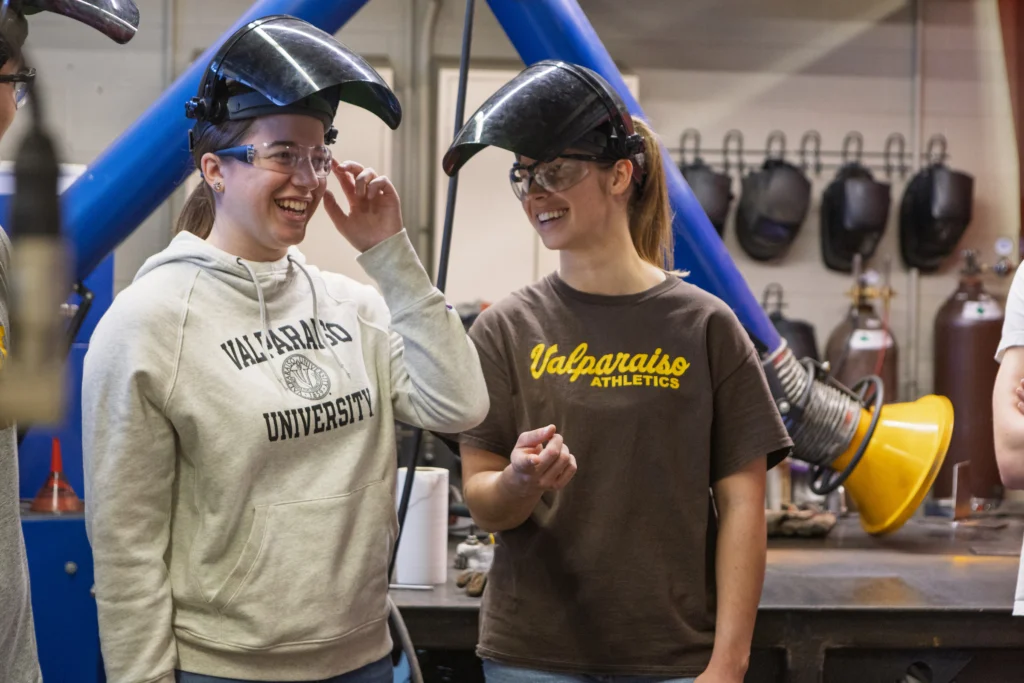
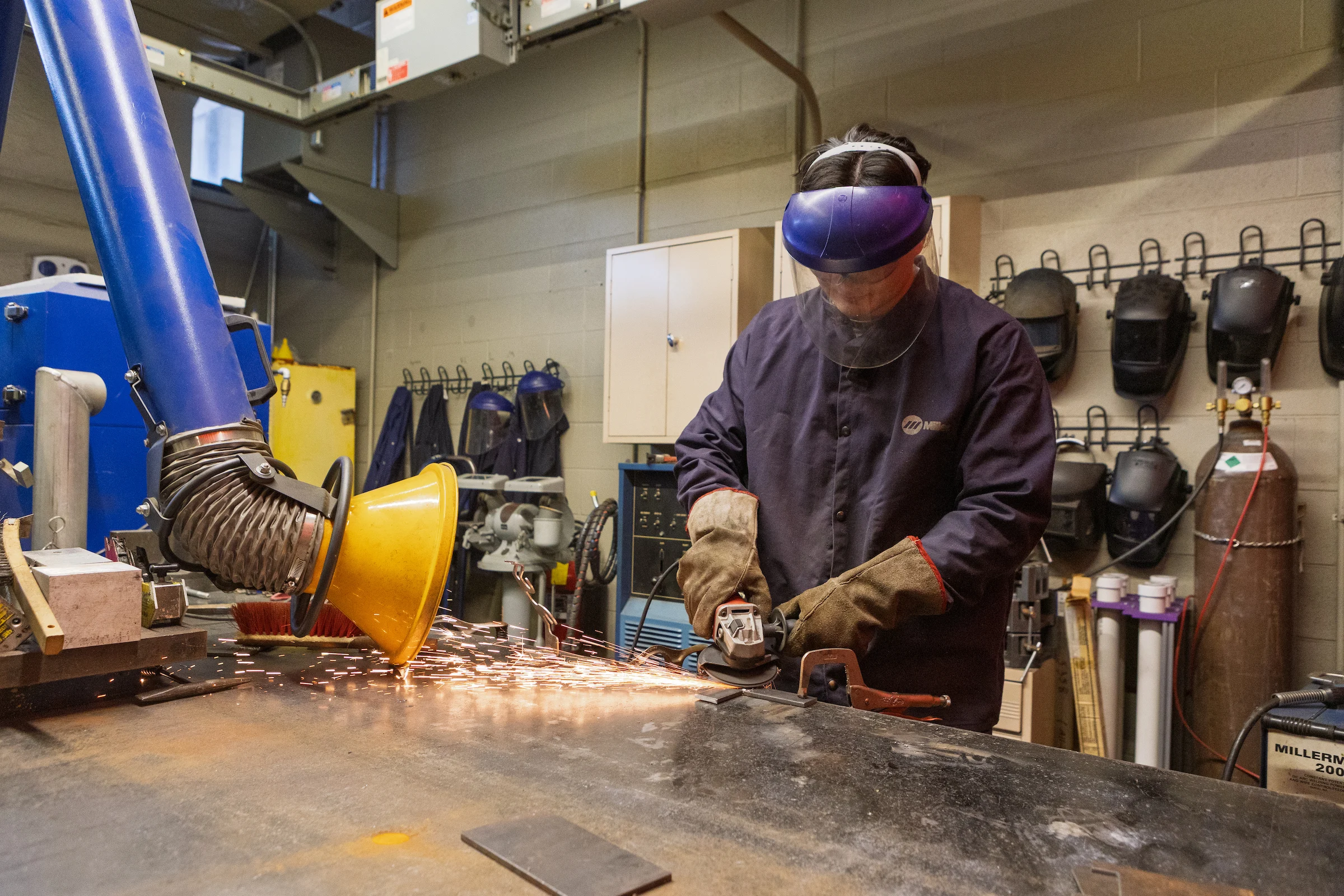
One of the ways Matt does just that is by encouraging his students to think like both designers and makers – specifically in his sophomore-level Introduction to Manufacturing course. “As a design engineer, you have to know how the parts are made, and it’s really easy to design a part you can’t actually manufacture,” he says. By the end of the semester, his students can manufacture parts on their own – a preamble to their senior design projects. “They can make their own parts, whatever they want: lightsabers, potato mashers, titanium pins…” Matt adds.
Simon takes a similar approach to building essential communication skills: “I don’t want them to worry about the grade. I want them to worry about knowing what they’re doing and sounding competent when they talk to another person,” he says. Along with providing recorded lectures and worked examples, he makes a point to strike up five- to 10-minute conversations with his students. “Learning to communicate is probably one of the biggest tools we get,” he continues. “Being able to explain technical stuff is great, but being able to just sit around and have a conversation… People will remember who you are. It will do wonders for their career.”
Their approach is paying off. “We have a pretty good rate of people getting hired,” Matt says humbly – with 100% of College of Engineering graduates employed or enrolled in graduate school within nine months of graduation.
Understanding the Student Experience
Because both Matt and Simon earned their own degrees at Valpo, they understand the demands that an intense engineering program can bring. “You have to let the students struggle a bit before telling them the answer,” Matt says. His rule is simple: Try it first. “At least put something down. Figure out where you’re falling short, and then come back. I’m happy to help!”
One of Matt’s favorite examples came from a project for CERN, where students designed a device to separate slightly radioactive debris, like glass and plastic, from mulch. A student brought him an ambitious design, expecting to be able to build it. Matt asked how, step by step, until the student saw the problems ahead. “They didn’t know what they didn’t know,” he says. The student refined the design several times, and once fabrication began, the project went very smoothly. “That’s going to change the way they look at a bunch of things in the future,” Matt adds.
“I understand the want for an A, but you don’t have to have an A. What you have to do is learn,” Simon agrees. “If you understand how [something] works, you can fix anything, because everything starts with a basic principle”.
Matt’s open-door policy encourages students to drop by to ask about homework, job offers, and questions they have about their everyday lives. It’s also his biggest word of advice: “Don’t hesitate to talk to your faculty and staff. Every faculty member I’m aware of in the College of Engineering is more than happy to help students learn, because that’s why we’re here.”
Matt and Simon are living proof of the Valpo promise: that the people who teach you also see you and understand you – because they’ve been in your shoes. “I feel that Valpo has served me very well, both as a student and as an employee,” Matt shares. “I’m super happy that I can come back and do the same, and help get our students out in industry with the right amount of knowledge, capability, and viewpoint.” Because that’s the goal: To provide the tools the next generation of Valpo engineers need to thrive.
Learn more about the College of Engineering and the brilliant, experienced people who help prepare Valpo students for what comes next: valpo.edu/college-of-engineering.