
AI Assistant

Research in Action

Valpo’s Mathematics and Computer Science department offers extensive research opportunities through academic-year and summer programs. Students work in teams, take on leadership roles, and present findings through various conferences and publications.

Mathematics & CS Department

Programs

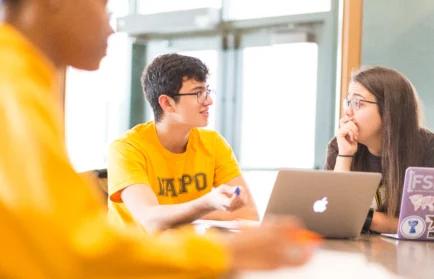
All incoming mathematics majors are invited to apply to join the academic year student research program — an opportunity to foster mathematical curiosity and develop independence and leadership skills.

The students participating in the research program are assigned to teams on the basis of their interests and talents. Usually, the team consists of students at a variety of levels. While newer students are expected to contribute to the research effort, their primary role is to learn about the research process. In particular, they are not being called on to guide the research effort, but are “interning” in the process. They will then be asked and expected to take leadership roles if they continue to work on research projects after their first experience.

The research teams stay together for a minimum of one semester, although it is possible for some teams to continue working on a project for longer periods. In the latter case, new students are introduced to the project as other students leave the team. Students are encouraged to commit themselves for two semesters of work on a given project. An active student could earn a total of eight credits for their research efforts over four years.

For a student perspective on what academic year undergraduate research is like, see:

The Department of Mathematics and Computer Science encourages its students to take advantage of opportunities to conduct research during the summer months at other institutions. Faculty advisors can be invaluable in helping students locate research projects that match their interests, as well as writing recommendations and offering advice on application strategies.

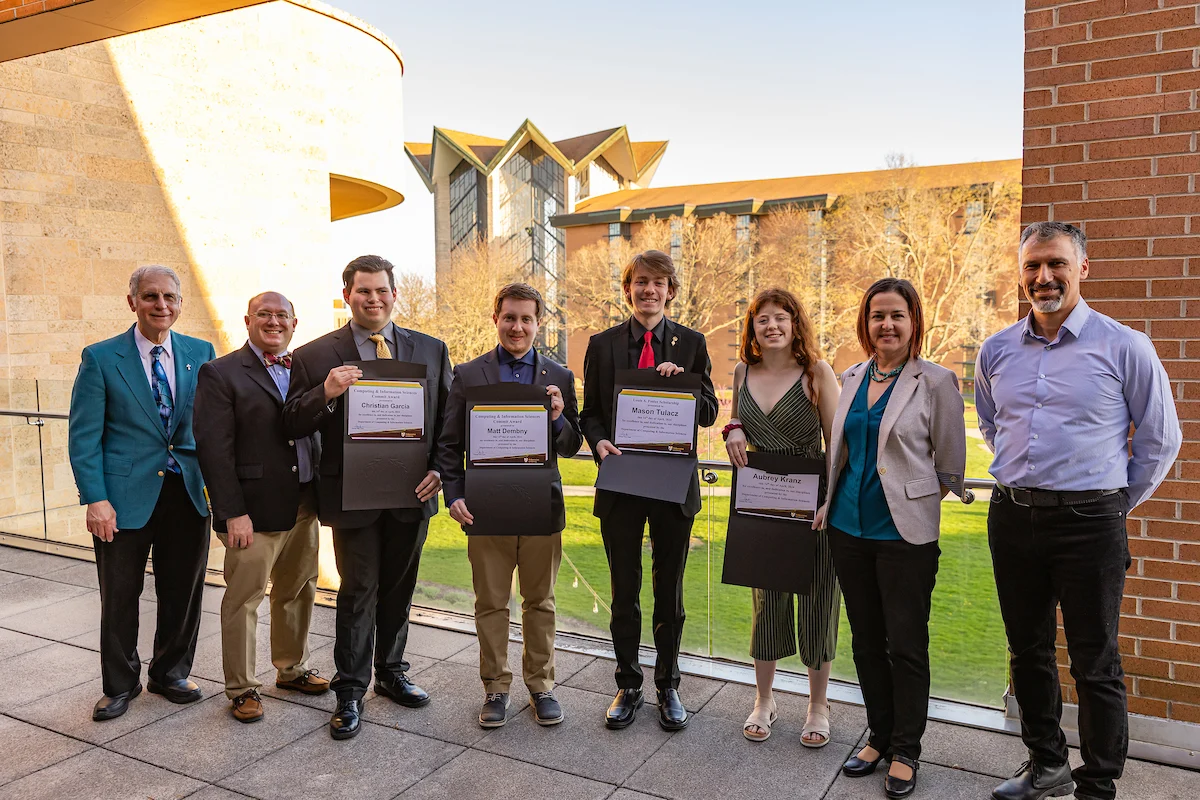
Students in the Department of Mathematics and Computer Science present their research findings in a variety of venues, including student and professional conferences at the regional and national levels. They are also regular participants in Valpo’s Symposium on Research and Creative Expression (SORCE), held annually in the spring.

Mathematics & CS Department

Previous Undergraduate Research Projects

  • “Find Your Calling Valpo Video Game” by Mason Tulacz
  • “MQTT-Based IoT Irrigation System with Network Performance Analysis” by Victor Kibet and Noah Christian James
  • “Implementation of a University Digital Token over a Peer-to-Peer Network” by Zach Faga
  • “General Purpose High Performance Computing for Valparaiso University” by Ben Gaddini and Noah James
  • “Modernizing HPC Lab Networking with Concurrent Dual-Stack IPv4/IPv6 and dnsmasq” by Samuel D Thyen
  • “Endurance Athlete Nutritional Tracking Mobile Application” by
    Ethan M Plank and Austin D Oh
  • “MESS: Extending an Industrial Production System” by
    Isaiah V Chairez, Zach J Faga, and Christopher R Huseman
  • “Smooth S.T.R.O.L.L.ing” by Nathanael W Haines and Max A Kotelnikov
  • “From Prototype to Production: The MESS Project” by Sam Thyen
  • “SDN-based Traffic Engineering” by Gregory J Freeman and Shaun Hicks
  • “MQTT-Based IoT Irrigation System with Network Performance Analysis” by Victor Kibet and Noah Christian James
  • “SDN-Based DDoS Detection and Mitigation” by
    Soilihi Cheikh Moussa Mahmoud Sir

  • “Fetishization and Representation in Digital Fan Spaces” by Mason Ellerbroek
  • “Hydraulics Lookup Tool” by Kurt Brown and Michael Albers
  • “The MESS Project” by Sam Thyen, Harris Gustafson, and Harley Eades
  • “Melin: Academic Reference Manager” by Harris Gustafson
  • “The X3 Guitar Processor: A Software Adaptation of Vintage Analog Technology” by Jacob Griffin
  • “Optimizing Resource Planning for the Perfect Cup” by Ben Gaddini, Matt Latzke, and Joel Osterhus
  • “Sensit Technologies Swiss Army Programmer (SAP) App” by Nate Beals and Aidan Vazquez
  • “Pest and disease detection in corn with AI” by Suma Dommati
  • “Security and Accessibility” by Ryan Nguyen
  • “AI-Driven Sales Data Analysis for Family Express” by Bhavaj Madev Varri, Manisai Chamakuri, Chinmai Pasupuleti, Srikrupa Gutti, and Prathyusha Marri
  • “Transforming Sales Data into Business Insights with Front-End Innovation” by Neha Bandi, Akshita Sangam, Sai Charan Chakravarthy Balusu, Uma Maheswari Balla, and Rahel Ahmed
  • “Backend Design and Development for Sales Data Insights Project” by Oluwaseun Sinkaiye, Bhargav Boyapati, Pradeep Kumar Bollepalli, Sashank Nahubandi, and Sai Krishna Rao Polasani
  • “Assessing the Effectiveness of AI-Generated Software in Withstanding Cyber Attacks” by Dominic Niceforo
  • “Evil Twin Attack Mitigation With Virtual Private Networks” by Harris Gustafson
  • “Predicting Running Backs Yearly Salary Based on On-Field Performance” by Kristian Simakoski
  • “Algorithm for Predicting Bitcoin Fees” by Mason Tulacz, Matthew Landrum, Kristian Simakoski, and Mason Ellerbroek
  • “Movie Recommendation System” by Vinay Kumar Karre
  • “Predictive Models for Health Monitoring in Wearable Devices” by Manideep Akkinapelli
  • “Predicting Chronic Disease Onset Using Wearable Data” by Irshad Shaik
  • “Improving Traffic Flow and Reducing Congestion Using Predictive Analytics” by Yashwanth Revu
  • “Predicting Professional Golf Success Using Amateur Rankings” by Caleb VanArragon and Matt Latzke
  • “A Nash Solution for the Ukrainian-Russian War” by Prashant Bhatta and Matthew Landrum
  • “Using Agent-Based Modeling to Reduce Traffic Emissions” by Caleb VanArragon
  • “Forecasting the Road Ahead: A Survival Analysis of Car Accidents in Chicago (2018-2024)” by Oracio Rosas
  • “Harre Union Photo Booth: Back End Overhaul” by Jake Wischer, Trent Miller, Lilu Smith, and Nathan Fox
  • “Did My Professor Waste Money?: Computational Cluster Configuration Variations and Cost-Efficiency” by Christian Garcia
  • “The Bane of the Ancients: A Software Adaptation of the Tabletop Role-Playing Adventure” by Jacob Griffin, Dominic Niceforo, and Charlie Hanson
  • “Can’t Hornswoggle an Old Salt Video Game” by Aubrey Kranz
  • “Using Word2Vec and N-Grams to Create Shakespearean Texts” by Hexin Liu
  • “College of Engineering Document Scanner Project” by Nicholas Sonntag, Hunter Peri, and Hexin Liu
  • “Cookin’ Time: Deploying a Satellite Synchronized Oven-Controlled Oscillator Stratum-1 Timekeeping System” by Matthew Dembny, Nathan Wessel, and Thaddeus Malatlian
  • “Apocalyptic Aversion: Converting a Tabletop Experience into the Unity 2d Environment” by Mason Tulacz, Ivan Ruiz, and Curtis Rias
  • “LyricSync” by DeAndre, Chisom Ogbuefi, and Ariel Fayol Ateufack Zeudom
  • “Loan Approval Prediction Based On The Decision Tree And Random Forest Methods” by Ravi Kiran Nimmagadda
  • “Independence in College Golf Scores” by Caleb VanArragon
  • “A Statistical Analysis of Valparaiso University’s Math Placement Process” by Anton Eschenauer
  • “Determining the Effectiveness of a Physician Assistant Curriculum using Data Analysis” by Nicholas Dietz
  • “Genetic Algorithm for Finding Maximum k-Distinct Lattice Paths” by Ariel Fayol Ateufack Zeudom
  • “Is the sales growth rate of electric vehicles related to the rate of growth of charging infrastructure?” by Amar Agrawal
  • “The Peasant’s Fell Bargain Computer Game” by Drew Simmons, Alyssa Matthews, and Ryan Nguyen
  • “Campus Information Prototype Application” by Charles Malachinski and Nick Bean
  • “A Look Inside: The Druid’s Reckoning” by Martha Aponbiede, Aiden Moran, Travis Biancardi, and Nicole Brown
  • “Predictive Analysis of AirBNB Properties in the City of Berlin” by Nikhil Shinde
  • “FUSTAL: A parallel statistics library in futhark” by Ethan Hawk
  • “AMM Historical Database” by Matthew Dembny, Chris Brown, and Beth Hanusin
  • “Distinct Lattice Paths” by Eric Yager and Marcus Engstrom
  • “iOS Application to Track Student Driver Practice Hours” by Thomas Hohnholt, Christian Garcia, and Alex Luke
  • “Residential Life Guest Business Process Support” by Jeremiah Johnson and Mackenzie Albright
  • “Geological Specimens Database Project” by Daniel Hautzinger
  • “Machine Assessment of Student Debate Postings” by Matthew Spivey
  • “Markiewicz Solar Research Facility Website Project” by Dawson Demien and Justin Layhew
  • “Tackling the Class Scheduling Problem: an Investigation Into Developing a Calendar Suite” by Fred Yaniga, Allura Magsino, and Rene Aguilar-Delgado
  • “Campanile Time Server: Chronologic Support for the S.E.R.F.” by Nathan Harmon, Graham Butler, and Spencer Gannon

  • “Combinatorics and GPU Programming” by Juan Arellano (advisor: Jon Beagley)
  • “Wolf Domestication: An Agent-based Simulation” by Ryan Kulwicki (advisor: Alex Capaldi)
  • “The Problem of Scoring Gerrymandering” by Junta Callahan, Jonathan Metcalfe, and Austin Schnoor (advisor: Mindy Capaldi)
  • “Generalized Motzkin Paths” by Michael Revor and Jacob Roth (advisor: Paul Drube)
  • “Determining the Optimal Design of Collegiate Ballroom Competitions” by Jonathan Metcalfe (advisor: Tiffany Kolba)
  • “Who will win the Stanley Cup?” by Nicholas Hollis (advisors: Tiffany Kolba and Coleen Wilder)

  • “Mathematical Modeling of the Evolution of the Domestic Dog” by Ashley Hire, Samuel Iselin, and Michael Revor (advisor: Alex Capaldi)
  • “Agent-Based Modeling of Pollen Competition” by Katie Bassett (advisor: Alex Capaldi)
  • “Distributions of Statistics over Pattern-Avoiding Permutations” by Michael Bukata, Ryan Kulwicki, Nicholas Lewandowski, Jacob Roth, and Teresa Wheeland (advisor: Lara Pudwell)

  • “Mathematical Modeling of Vaccination Noncompliance” by Jordan Bauer (advisor: Alex Capaldi)
  • “A Simulation of Anthropogenic Mammoth Extinction” by Matthew Klapman (advisor: Alex Capaldi)
  • “Jeu de taquin of set-valued Young tableaux” by Benjamin Levandowski and Nichole Smith (advisor: Paul Drube)
  • “Statistics of FA cup Final” by Jonathan Heagy (advisor: Pat Sullivan)
  • “L(4,3,2,1) – Labelings of Graphs” by Davina Boykin, Samuel Iselin, and Hector Reyes Figueroa (advisor: Zsuzsanna Szaniszlo)

  • “Original Geometric Theorems About Triangles” by Katie Lezark  (advisor: Mindy Capaldi)
  • “An Agent-Based Modeling Approach to Determine Overwintering Habits of American Robins and Eastern Bluebirds” by Samuel Iselin and Shannon Segin (advisor: Alex Capaldi)
  • “Combinatorics of Twist Boxes of Knots” by Nichole Smith (advisor: Paul Drube)
  • “Descent Statistics on Shuffles” by Felipe Alzate, Bill Mackelfresh, and Lily Wisniewski (advisor: Lara Pudwell)
  • “Modeling Promotion and Relegation in English Soccer” by Matthew Eifert and Brian Thompson (advisor: Pat Sullivan)

  • “Investigating the Study Habits of Math Students” by Brooke LeFevre (advisor: Mindy Capaldi)
  • “Misconceptions in Elementary Mathematics” by Katie Merkling and Rachel Rockey (advisor: Melissa Desjarlais)
  • “Non-crossing Matchings in Annulus” by Puttipong Pongtanapaisan (advisor: Paul Drube)
  • “Generalized Non-crossing Matchings” by Abigail Larson and Samuel Brandt (advisor: Paul Drube)
  • “Characterizing the Properties of k-Dense Graphs” by Samuel Prahlow (advisor: Karl Schmitt)
  • “Parameter Optimization for a Model of the Thermonuclear Reaction in Magnesium” by Will Arloff (advisor: Karl Schmitt)

Contact the Department

Valparaiso University’s Department of Mathematics and Computer Science welcomes inquiries from prospective students, fellow researchers, and community members.

Professor Tiffany Kolba, Ph.D., Department Chair

Mathematics and Computer Science

tiffany.kolba@valpo.edu

Gellersen Center, Room 112
1900 Chapel Drive
Valparaiso, IN 46383


You Belong Here.