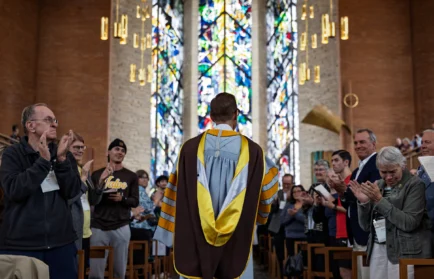

The Valparaiso University Satellite Team gathered to watch the launch of their first major project through SpaceX on Monday, March 30, 2026. The launch is the culmination of a project begun in 2024, when the team joined five other Universities in the region in NearSpace Education’s Dream Big Program to collaborate on different elements of a satellite. The Valparaiso University team has been responsible for designing and building the payload — a system which will allow ground stations to download data from the satellite.
“The satellite team has grown greatly over the course of this first complete concept-to-launch project. Real deadlines, real hardware, real software (with real bugs), give the active members direct experience in the wide variety of skills used in a space mission. said Dan White Ph.D., associate professor of electrical and computer engineering.
A recording of the launch can be viewed here.
“Everyone has poured so much time and effort into this project that I think we’re all ready to see it in action,” said Mackenzie Blanton ’28, an electrical and electronics engineering major. “There is also a great sense of pride in not only myself but my team as well. VSP Alumni and new members have worked very hard, I can’t wait for everyone to see Valpo’s first satellite.”
Prior to joining the collaboration, the Valparaiso University satellite team had been in the process of designing a complete PocketQube satellite of their own, with plans to seek an opportunity for launch at a later date. That changed when Dan White, Ph.D., assistant professor of electronic and computer engineering with Valpo’s College of Engineering, met NearSpace Education representatives at the 2024 Small Satellite Conference in Utah, who ultimately offered Valpo a place in the collaboration.
Reducing the scale of the build made things more manageable for the Valpo team, but the project still required extreme precision and meticulous planning to produce a usable payload. Due to the limited space on the satellite, the final product had to meet exact parameters to fit, and every gram of weight counted towards the success or failure of the effort.

Collaboration and Campus Improvement
The Dream Big project and NearSpace Education’s mission is to inspire STEM students of all ages. To support that mission, outside of the payload project itself, the Valpo team hosted three high-altitude balloon launches in 2024 and 2025, inviting local schools and youth organizations to get involved with scientific research. Participants attached a variety of objects to the balloons — such as marshmallows and soda cans — to see how they would respond to atmospheric changes.
“The high-altitude balloon launches also in partnership with NearSpace Education and Dream Big have proven to be an amazing recruiting tool, one third of the team is now dedicated to developing our second generation of balloon flights,” Professor White said.
In addition to being an opportunity for education, the launches were an excellent chance for interdepartmental collaboration between Valpo programs. The coordination and execution of the balloon launches were handled by the University’s geography, meteorology, and environmental sciences department, while the education department played a major role in coordinating with participating schools.
The team also required advanced facilities to handle the more delicate parts of the manufacturing process. Thanks to a generous donor, the Gellerson Engineering and Mathematic Center is now home to a clean room — a space with a strictly controlled count of airborne particles per cubic meter of air.
Professional Opportunities
While having a project launched into space is a major achievement, the ultimate goal of the College of Engineering and Valparaiso University as a whole is to prepare students for successful careers in industries they’re passionate about. Alumni of the Valpo satellite team have already taken professional opportunities to enter the aerospace field as dedicated professionals.
Even prior to the launch of the project, graduates from the Valparaiso University Satellite Team have turned their experiences into career advancement. Alumni Thaddeus Malatlian ’25 and Ben Jones ’25 have pursued opportunities with United Launch Alliance (ULA) and NearSpace Launch, respectively. Both Valpo grads use the technical skills they learned from the College of Engineering and the passion they explored through the Satellite Team to make a real difference in the industry.
Today, as part of the NearSpace team, Jones designs, tests, and troubleshoots spacecraft electrical systems, ensuring compliance with industry standards while continually refining and improving designs.
“Going into my current role, that transition felt very seamless, as I was able to apply my skills directly and build on them in a practical setting,” Jones said. “The experience gave me confidence working on real systems and helped prepare me for the expectations of my current position.”
Malatlian was able to intern at ULA prior to graduation. As an intern, he worked on electromagnetic compatibility and interference, from the payloads headed to space to lightning strikes from nature. His work was critical to ensuring that nothing disrupted the launch process. Now he works for ULA full-time as an electromagnetic compatibility engineer.

What Comes Next
The satellite may be launched, but the Valpo team’s job is far from over. Students will continue to operate their part of the satellite for as long as it stays in orbit.
“It is a great feeling that this hardware has made it to launch day. I’m looking forward to the first contact with it and the BCON-2 team transitioning to operating their satellite payload and extracting as much data as possible from it,” Professor White said. “This includes running experimental campaigns with the hardware hosted on BCON-2 from the University of Luxembourg’s Space Systems Engineering group that generates magnetic fields that create forces against the Earth’s magnetic field to turn the spacecraft, called an attitude-determination and control system.”
In the meantime, a third of the team has already begun work on their second satellite BCON-1, learning everything they can about the structure of a 1P PocketQube — an ultra-mini, cost-effective, 250 gram satellite. The group’s next step is to perform antenna deployment testing before the end of the school year. Additionally, groups within the Valpo Space Program will begin independently launching high-altitute balloons.
“I am excited for our future and hope to continue building Valpo’s reputation within the aerospace sector,” said Blanton.
For more on the story behind Valpo’s first satellite project, see previous articles here and here. For more exciting projects from Valpo’s College of Engineering, read about the students exploring new methods of 3D printing, or how students are taking their education abroad.